



How an Inventor’s Collection Is Shaping the Next Generation of Musicians
Most people know Dr. James Robert Cade as the lead inventor of Gatorade. Fewer know that on the title page of his autobiography, Freut Euch Des Lebens (Take Joy in Life), he described himself as a “physician, scientist, musician, and inventor” — in that order.
Music wasn’t a footnote in Dr. Cade’s life. It was foundational. He began playing violin as a child and continued into adulthood, performing with the University of Florida orchestra. By the time of his passing in 2007, he assembled a remarkable personal collection of violins violas, cellos, and bows — some dating to the 17th century.
That collection now lives at the Cade Museum. And it’s still being played.
Instruments with a Purpose
Since the fall of 2009, the Cade Museum Foundation has loaned instruments from Dr. Cade’s collection to music students at the University of Florida through what is now formalized as the String Fellows program. The program is a partnership between the Cade Museum Foundation and UF’s School of Music, under which instruments and bows are loaned to students for their educational advancement.
The process is as meaningful as it is practical. Participating students are invited to the museum to play several instruments from the collection and select a favorite violin, viola, or cello and bow. That instrument stays with them for the academic year, available for daily practice. In return, students perform at select Cade Museum events, connecting their musical development to the broader community the museum serves.
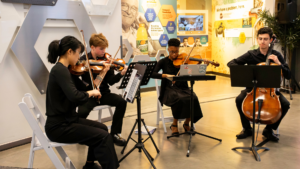
Participants playing at 2023 Cade Prize Awards Ceremony
A Growing Collection, Preserved for Education
The collection came to the museum in stages. In 2016, the Cade Museum received ownership of 11 instruments from the family, followed by 14 more in 2018, 10 bows in 2017 and several instruments were gifted to the museum, bringing the total to 31 instruments and 20 bows.
The collection is classified as both permanent and educational. Not every instrument is currently in playable condition, and the museum is actively restoring and preserving those that need attention — keeping the collection a living educational resource rather than an archival one. A recent grant from the Bruce J. Heim Foundation has helped offset the cost of this work, but ongoing instrument and bow maintenance remains essential to keeping the String Fellows program running and accessible to students each semester.
The Impact
According to Abigail Carpenter, a violinist pursuing her master’s in music performance, the String Fellows program has helped her grow as a young professional musician. “Having access to one of their bows has significantly elevated the depth, clarity, and consistency of my sound, directly influencing my performance in orchestral leadership roles, chamber music, and solo settings. Beyond the physical instrument, the program represents an investment in my potential. That support has strengthened my confidence, expanded my artistic capabilities, and allowed me to pursue opportunities at a higher level than would otherwise have been possible,” she said.
Dante Jordan, a senior violin and astrophysics double major, first heard about the program when he auditioned for the school. “It’s a substantial part of the reason why I chose to attend,” he said. The program has “allowed me to explore a caliber of instruments and sounds that would normally be locked behind a pretty substantial paywall… It’s also reassuring knowing that if anything should happen to the instrument, I can take it to get fixed without having to worry about money coming out of my own pocket, keeping the entire process as stress-free as possible.”
Support the Music. Honor the Legacy.
Dr. Cade believed that a life fully lived meant pursuing science and art, discovery and beauty. The String Fellows program carries that belief forward — placing historic instruments into the hands of students who are just beginning their own creative journeys.
Your gift to the Cade Museum helps restore and preserve instruments from Dr. Cade’s collection, ensuring they remain playable and accessible to UF music students for years to come. Every donation directly supports the program’s ability to license instruments, fund conservation work, and expand opportunities for the next generation of musicians.